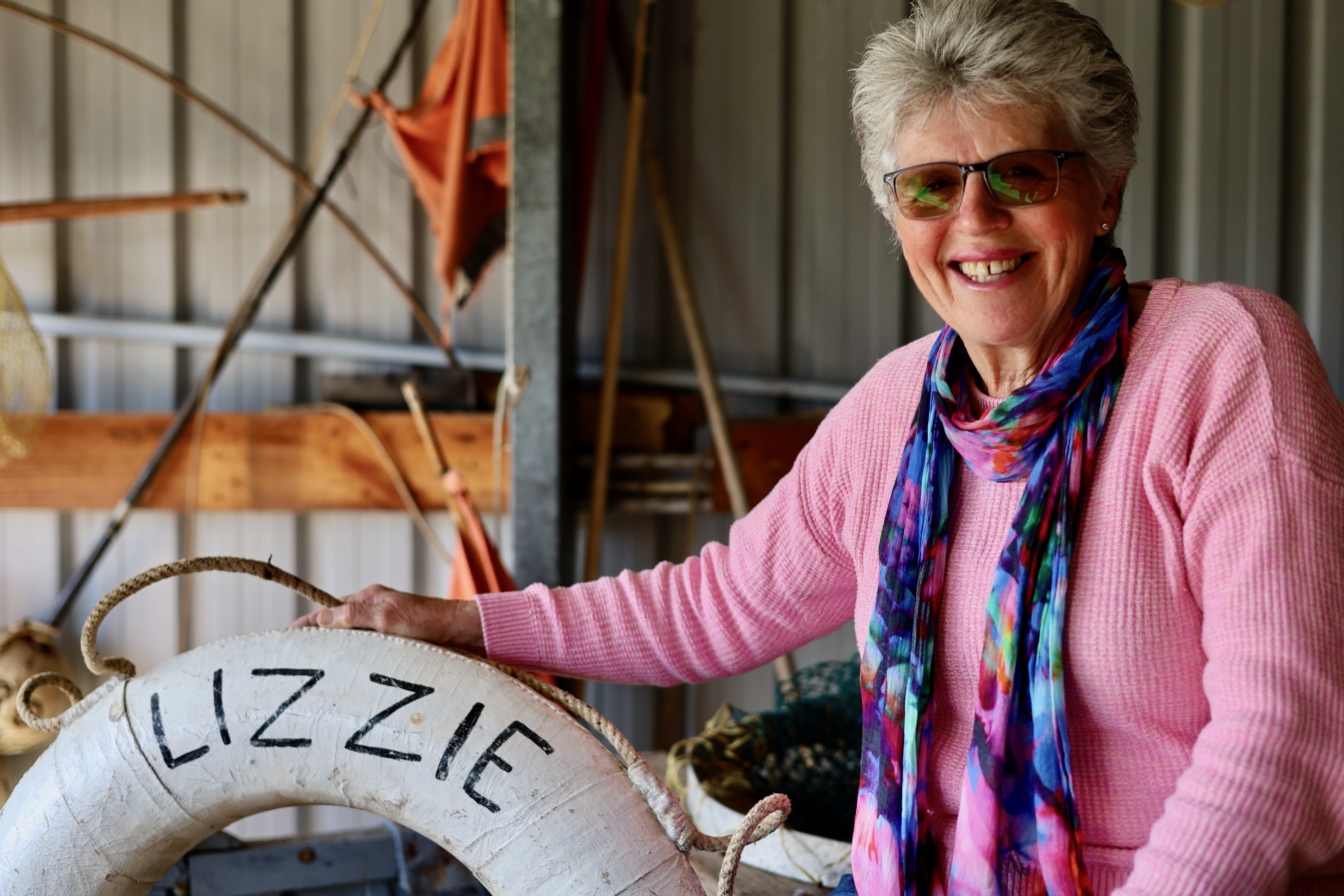
“How lucky I feel having lived my life in St Leonards. Born into the very large extended RIGBY fishing family and being privileged to spend many years with my grandparents, I have such a wealth of personal and family history of our town. My great grandfather George Rigby was born in Paywit (Indented Head) in 1866. Being a good Catholic family he and his wife Elizabeth bore 12 children; eight boys and four girls. There used to be a saying ‘if you shake a tree, a Rigby will fall out’. My grandfather George Francis Rigby was the oldest surviving child and he, together with his brothers Dommy, Danny, Bernie and Jimmy fished from St Leonards until they retired. My dad Vin and his older brother Francis also were commercial fishermen until they retired. One sister, Dolly Bell, stayed local and with her brothers was largely responsible for the building and early upkeep of the Catholic Church.
The Catholic Church was constructed next to the primary school in the very early 1960’s. Prior to this the Memorial Hall was used for mass on a regular basis. In the mid 1950’s I was christened in the hall while it was in ‘Catholic Church’ mode as were most of the younger Catholic locals. We grew up as what can best be described as ‘bush Catholics’. Once we started school a group of nuns would round us up about once a year and take us around to Portarlington to be taught about religion. To me it was odd as the local Anglicans would have a weekly religious instruction class at school with a dear local lady, Mrs Littley, who always brought afternoon tea. All the bush Catholics were made to stay outside in the shelter shed and play ‘pussy in the corner’ (the child in the centre would try to make it to a vacant spot along the wall as others dashed from side to side). I didn’t enjoy being a Catholic as my mother was not of that persuasion and would send me to school with Pork German and tomato sauce sandwiches. It took years for me to figure out why the more ‘educated’ young Catholics would insist I removed the meat on Fridays.
The St Leonards pier, hotel and ‘Big Store’ were the hub of the town. The breakwater extended well southward and the harbour was full of mostly Couta type fishing boats, many owned by my family. In the early 1960’s Scallop boats also moored in the harbour. There were no boat ramps so the wooden boats were manually hauled onto the beach using the old winch, rollers and man power for their annual scrub down and coat of anti-fouling and paint. Some of the older more neglected wooden boats were left in the old creek which was located in the middle of the existing camping ground. The creek was like a dark lagoon surrounded by large cypress trees in black sand and every now and again would open up to the sea; sometimes through weather conditions and at other times dug open by hand. It was filled in following the floods in the early 1970s and the water overflow from the lake was redirected to where it currently runs into the bay.
Fishing and the sea consumed most of my dad’s life. He worked long, hard hours in all sorts of weather as did his extended family. Often just under sail and running with the tide; he had a remarkable knowledge of the bay and weather patterns. I can remember him catching such a huge shark he had to tow it in. As the town was small and word travelled fast we, as school children, were marched down the pier to view the catch along with most of the other locals. Dad realised when he began to land it on the pier it was pregnant with smaller sharks, which were given away. This obviously upset dad and future large shark captures were released back into the wild. Several times he caught the same shark (it had special battle scars) and it really gave him joy to set it free.
Many family fishing boats have come and gone over time however one rates a special mention. The historic family wooden couta boat was called ‘Lizzie’. She was built by my grandfather and his uncle Ned, some time before WW2. My grandmother regularly rode a push bike to Queenscliff to buy the copper nails. Lizzie was so structurally secure it was a common belief that if she was ever scrapped, she would be worth a fortune in copper. My dad, as a youngster together with his uncle won the ‘All Yacht and Fishing Boats Race’ in December 1945 in Lizzie, racing her under sail around the bay. The family still have the first prize mantle clock which is always proudly on display. Wooden boats require lots of maintenance and sadly Lizzie was sold on and is now moored in Portland.
The pier with its large crane was a magnet to all the young folk during the summer months, particularly when we all started high school. Some wouldn’t even go home from the schoolbus, just straight down the pier to jump off and cool down. We had shell-grit brick change rooms and toilets in Harvey Park, and a large shelter shed which faced the pier. The local primary school children were taught to swim at the beach earning their Herald certificates; few knew what a swimming pool looked like.

Una with a photo of the Jetty showing the couta boat fleet. The photo is from an old post card. The family Combi van can be seen just in front of the building on the pier.
The hotel was quite a gathering spot for the fisher and working men of the day. Six o’clock closing was the law. I would sometimes stand in for my cousin Allan Rigby who was the local paper boy, selling papers outside the hotel on a Saturday night when I was only ten. It used to fascinate me how the local publican Tommy Ryan would stand and hold the door open each night from 6:15pm onwards shouting out “Thank you gentlemen” to get all the blokes out of the pub and send them home.
Next door to the hotel, facing the sea and on the same block of land was another small shop with a residence attached. It was always known as the Milk Bar, however it stocked a variety of goods and at one stage was the newsagent.
The Big Store on the south side of Murradoc Road was just remarkable. Everything from Post Office and telephone exchange to an early style supermarket. It was such a gathering spot for the youth of the day, particularly with the addition of a juke box. It had one or two petrol bowers out the front and sold everything; even beach clothing in the summer months. I think many of us youngsters had a turn at being employed by the owners at one stage or another. Sadly it burnt to the ground in March 1981 and was replaced with the current block of five shops.
The St Leonards Hardware was one of the first occupants at the west end of the new complex before transferring across the road to its current location.White Fisheries were located in the middle shop of the new complex; my dad sold his catch to Dennis White right up until he retired. The White family business has since relocated to Murradoc Road in Drysdale. The nearby chemist shop was built just prior to the replacement shops being built.
St Leonards also had a huge timber and hardware store in the late 1950’s and early 1960’s; with a hardware shop at the front and timber yard at the back. Local builders included Eric Hanslow and Stan Knox and plumber Tom Johns. It was obviously too far ahead of its time and eventually closed. The front shop section at one stage became the post office and later a variety of seasonal type stores. The shed at the back was owned by Ray Mackie and family selling fresh fruit and veg. All was demolished to make way for the current IGA.
We had our very own bakery in the very early days, called the Nutty Crust bakery. It would just about kill my dad (the world’s greatest bread eater) having to endure the smell of freshly baked bread while sitting down in his boat baiting up his long lines at 2am. We kids would fight to go to the bakery. Firstly everyone wanted the crust of the bread when we got home – in the days before bread was automatically sliced. Such an assortment of bread – Devons, quarter, half or full high tins, pipe loaves and Vienna’s. The bakery would often give us a bag of cake ends – what a treat. I still enjoy the bum end of cakes and slices. The funniest of all, we cherished the tissue paper the bread was wrapped in. You must remember we lived in a world of outback dunnies with torn up newspaper threaded through string. Sadly like many of our earlier shops, the bakery just appeared to fade away. Thankfully at a later stage the Talevski family moved into town and set up a bakery at the east end of the new shopping complex, eventually moving across the road to its current location. Again my ever hungry dad savoured the early morning smell of freshly baked bread.
Another branch of the Rigby family, Ken and Valda Allender, opened a butcher shop on the corner of Blanche St and Murradoc Road (where Mira’s hairdressing is now). My grandmother would send me up to the butcherswith coins tied into the corner of a handkerchief and a shopping list. It worked well until one day I decided to twirl the hanky around like a propeller and the knot came undone and coins went all directions, most of which I couldn’t find in the long grass. Needless to say, lots of tears and hugs lead to me being allowed to take my nana’s purse on future visits. The shop eventually changed hands but business faded with meat packs being introduced to grocery stores.
St Leonards also had a café and several take-away food stores which came and went. I worked in Wheelers Café weekends and holidays from the age of ten – it’s really ridiculous to think of now, but can remember working there the day the then Prime Minister Harold Holt went missing at Pt Nepean. Another of the smaller milk bars in which I worked introduced me to microwave ovens. I was amazed at how one could get so burnt with hot jam from a donut that had only been in this new flash oven for 30 seconds.
Bluey Mac’s Fish and Chip caravan was open every Friday and Saturday night on what we still call ‘The Green’ (the north east corner of the car park in front of the hotel). The council eventually allowed a small permanent kiosk to be built there. People would come from far and wide for the best feed of fish and chips on the peninsula.
A service station and garage was built on the corner of Murradoc Road and McLeod Street in the 70’s but was eventually closed down with the garage and underground tanks removed. It’s a wonder it survived as long as it did as we had several town Guy Fawkes Night bonfires just across the road, near the lake right up until 1979.
My uncle Francis Rigby, in addition to being a commercial fisherman, and his family ran a fish shop and cool storage business from the family home in Dudley Parade. The very large cool room was used by local fisherman and also held stocks of ice. My uncle had a VW Kombi van and often drove over to the ice-works in Queenscliff to replenish stocks of ice. Electricity was still very new in the town and many still had ice-chests (not fridges). During the summer holidays the family regularlydid an ice run through the camping ground as most still used ice as their primary source of refrigeration. I can remember my uncle singing out loudly “Ice, Ice-O” and dragging huge blocks of ice with giant tongs and using the ice-pick to break them into smaller blocks. The kids loved the shards of ice – as good as an ice-cream.
Our camping grounds spread along the foreshore from Second Avenue in the north to the Bluff in the south. I think at one stage visitors were allowed to camp on the lower bluff just north west of the Yacht Club. We also had a few beach bathing huts built on the beach near Second Avenue and near the boat ramp (not quite as colourful as those in Brighton). There was also a small jetty between the Bluff and the Yacht Club known as ‘Jamison’s Jetty’. Unfortunately neglect and the weather washed them away.
During the summer as youngsters we had an assortment of entertainment that came and went. There were trampolines, a circus and horse rides on The Green, a pin ball parlour in the town and paddle boats on the foreshore. This was in addition to our regular local sports teams that grew as the town developed.
In my very early days we had many products home delivered. There was ‘Jim (Bailey) the butcher’ from Portarlington who delivered fresh meat once or twice a week. Arnold Trewin (the world’s most loyal Essendon supporter) would deliver milk daily. The Trewin family owned the farm where the Sea Change Estate now stands. Bread would be delivered a couple of times a week from Bellarine ‘Fitzy’s slice is twice as nice’. Any every now and again we would get a travelling salesman, Jack Antoon, selling everything from pears preserved in glass jars to undies.
I wouldn’t have wanted to grow up anywhere else.
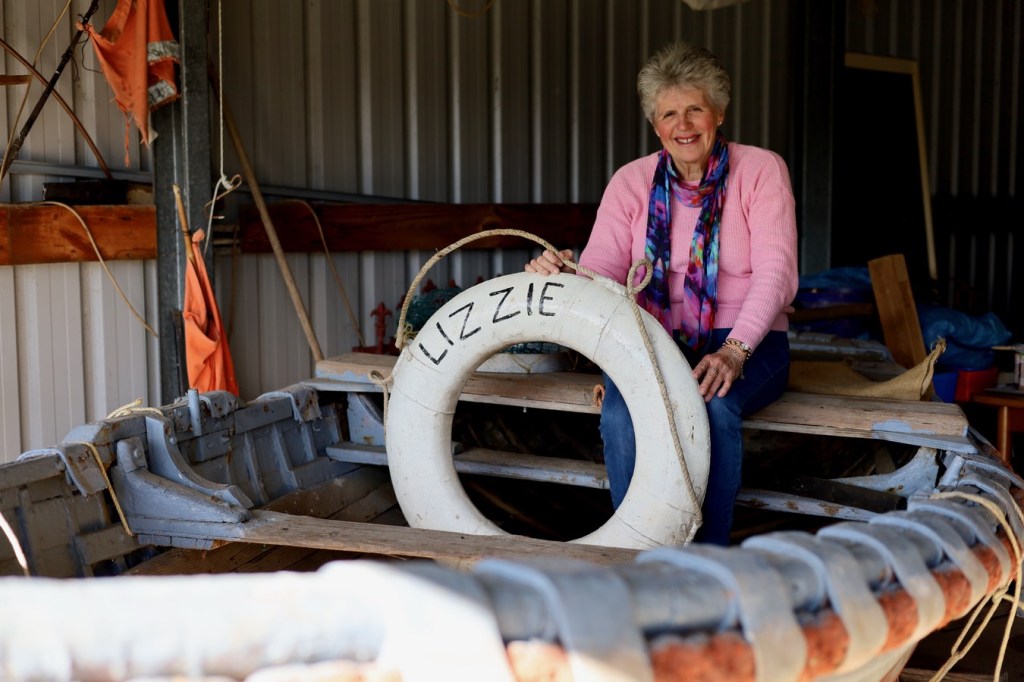
Una and the very old and well used Rigby family ‘clinker built’ dinghy. Built by older family members in the mid 1900’s and used by all generations until recently. “Lizzie” is from the family built Couta boat, now moored in Portland.
 Humans in St Leonards