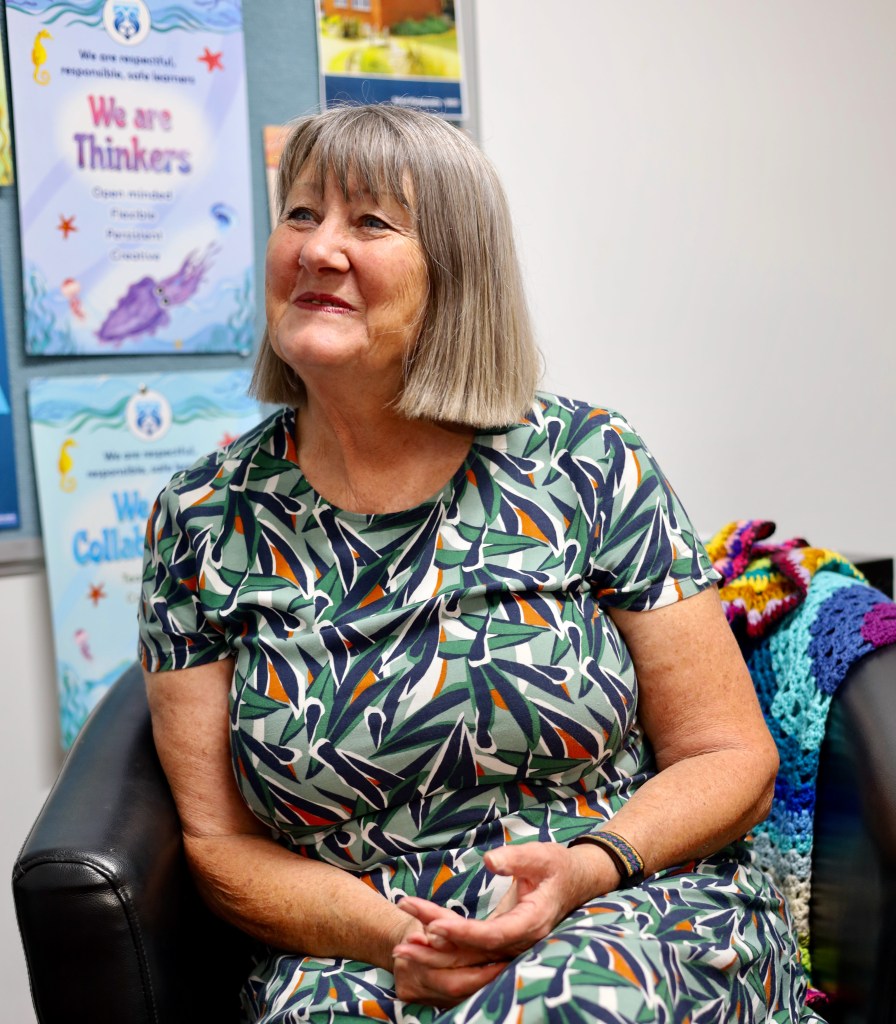
Tasmanian born and raised, Jenny Cowburn says she always wanted to be a teacher. She began her career in childhood practising on her younger sister and a little later undertook more formal teacher training in Hobart. During her teacher training Jenny engaged in the visual arts, particularly ceramics which is a passion she intents reigniting during retirement (spoiler alert) which is due to begin in April 2024.
After graduating Jenny taught in small town schools around Hobart (the splendidly named Bagdad being just one) and continued to develop her passion for the arts and pottery and skills in leadership.
In 1992 she moved with her husband and two young children to Melbourne for her husband’s work. Small schools have always been Jenny’s interest and the family’s preference has always been to live in smaller towns and on the city outskirts where the sense of community is strong. It was however at the beginning of the Kennett years and hundreds of smaller schools were being closed. Her first teaching job in Victoria was at Tarlinain Cockatoo an independent school (now closed) near Upper Beaconsfield. When the family moved to Gisborne Jenny picked up relief teaching work at local schools, then a more permanent position at Riddells Creek Primary School teaching art. It was there she began to further her interest in leadership and exploring the ‘inquiry’ approach of learning. This approach is based on delving into student, environment or community interests and passions, and through these, engaging students in activities to findout more, ask questions, look at, make sense of, and communicate findings, explanations or arguments. Jenny says ‘student choice and voice’ is a huge part of this approach. Many will recognise this approach as having sat behind the (very persuasive and successful) whole-of-school campaign to save the St Leonards Pier in 2022.
The family had a holiday house in Barwon Heads so when a job came up as Principal at Queenscliff Primary School in 2012 Jenny applied and was successful. This was her first role as Principal, and having said small schools were her passion Queenscliff – with a student population dropping to six at one stage and two teaching staff including Jenny and one part-time admin staff member – ‘was a real challenge’. Over the space of four years, the school population grew and Jenny started to learn about the local environment, the land and sea, with the active support of the nearby Marine and Freshwater Discovery Centre in Queenscliff and Bellarine Catchment Network. Learning about the environment was layered with the arts. Jenny said she learnt a lot in her time at Queenscliff, particularly about getting to know the local community.
While at Queenscliff Jenny became aware of a principal position coming up at St Leonards Primary School. In 2016 she came to St Leonards in the acting role and later that year the position of principal was hers. There were 82 students at St Leonards at the time. The town has grown since then which is reflected in the school currently having 153 students.
Jenny says proudly you ‘couldn’t find a better place to be a principal.’
The school population has always included children and their families with high support needs, students who stay for a short time in the area and students who are being raised by their grandparents. It ‘was important for the school to cater for the whole range of students’ and ‘connection to community’ is a big part of that. Having students and their families connected to the St Leonards community and the wider community wrapped around the school and its students, enables the students to ‘grow into connectedness’ and become community minded with a sense of responsibility and belonging.’
The retired community, many with no familial connection, are a rich resource for the school, many becoming volunteer readers. The support and pride of the town is felt strongly. This is often evident by ‘likes’ on the school’s facebook page as well as the willingness of our community groups and local businesses to become involved and offer whatever support they can, such as fundraisers. But also through opportunities for student to participate, as with the student leaders who attend St Leonards Progress Association meetings to offer a young perspective to matters of concern or interest in the community; or with the partnership with the Men’s Shed each Christmas to create decorations for the Dan Dan Nook playground.
Jenny says ‘being a principal during COVID was one of her proudest moments’. She says many people looked to the school for leadership amidst a time of many great unknowns. The school made a number of brave judgement calls, never really sure in the early days if it would help or make matters worse. What happened though, was all teachers wanted to come to school, they absorbed fearfulness and turned it into ingenuity,they learned to teach online and made up book packs to support student learning at home, they disinfected everything to within an inch of its life, and enabled students who could not stay at home to come to school. Jenny says ‘staff and parents were amazing.’ Many parents who were home schooling their children, gained an appreciation for ‘what teachers do’ and more specifically ‘how patient teachers are’. Jenny said that it was during this time, when she would begin her day as she had always done, with a walk along the foreshore and ‘one of the saddest things was seeing the playground taped up’.
Some years ago the St Leonards Primary School had something of an unfavourable reputation, primarily associated with perceptions around the schools’ relatively high numbers of ‘disadvantaged’ students – students who had learning, emotional or behavioural difficulties. This is where the St Leonards Learnersframework which embodiesthe schools values and the beliefs about inquiry based learning comes in. Represented by marine animals found under the pier, the seahorse, the school’s symbol is the ‘wise one’ representing the school values. The other five animals represent the ‘five learner strengths, vital to becoming a lifelong learner.’ There is a school of whiting for ‘collaboration’, a banjo shark for ‘self-management’, a snapper for ‘communication’, a cuttlefish for ‘thinking’ and a puffer-fish for ‘research’. St Leonards Learners is also about being ‘respectful, responsible and safe, and nurturing a future capable person and a great person’. It is a strength based and whole-of-school community approach. It is ‘a belief about what our kids can be,’ the structure for learning, and applies to staff, the school council and parents just as much. It is also the basis on which the culture of the school is made and will continue.
The physical school environment also reflects the St Leonards Learners framework. You might have noticed the addition of a chook pen (chooks are excellent to cuddle when students are feeling upset or anxious) and the beginnings of a Regenerate Our School project pending funding. The main school building is a 2012 design with class ‘rooms’ located around a central open space. Jenny said it was not without its drawbacks, such as distracting noise levels, though she said this has settled and everyone adapted by following the learners concepts. The central space is used for school assemblies and for students who need to step out of the classroom for a while.
Three years of COVID has meant some students are experiencing difficulty with attendance, social interaction, and poor mental health such as anxiety. Students experiencing distress or difficulty coping are supported by two wellbeing leaders who will work with them to assist them to settle and get them back into the classroom and learning as soon as possible.
Jenny explains, ‘the key thing about the school, and learning is relationships’. Relationships enable ‘trust to be built, a sense of ‘we can do this together’ and being a learner. Fundamentally though, the ‘bread and butter of primary school is literacy and numeracy.’ Literacy and numeracy are the main focus, and the essential building blocks of work to be undertaken in the early years. The learning is facilitated by the inquiry approach and, as much outdoors time as possible.
Jenny says the fact that there is ‘no problem with staffing is a nice indication.’ We think it might be a bit of an understatement. The whole community is immensely proud of what has been achieved and of what the school has become in Jenny’s time as principal – and will continue to be. It is the little school that punches well above its weight, and has come a long way in growing a connected community; inspired teachers; amazing students and young leaders; as well as capable and great people of our future.
 Humans in St Leonards